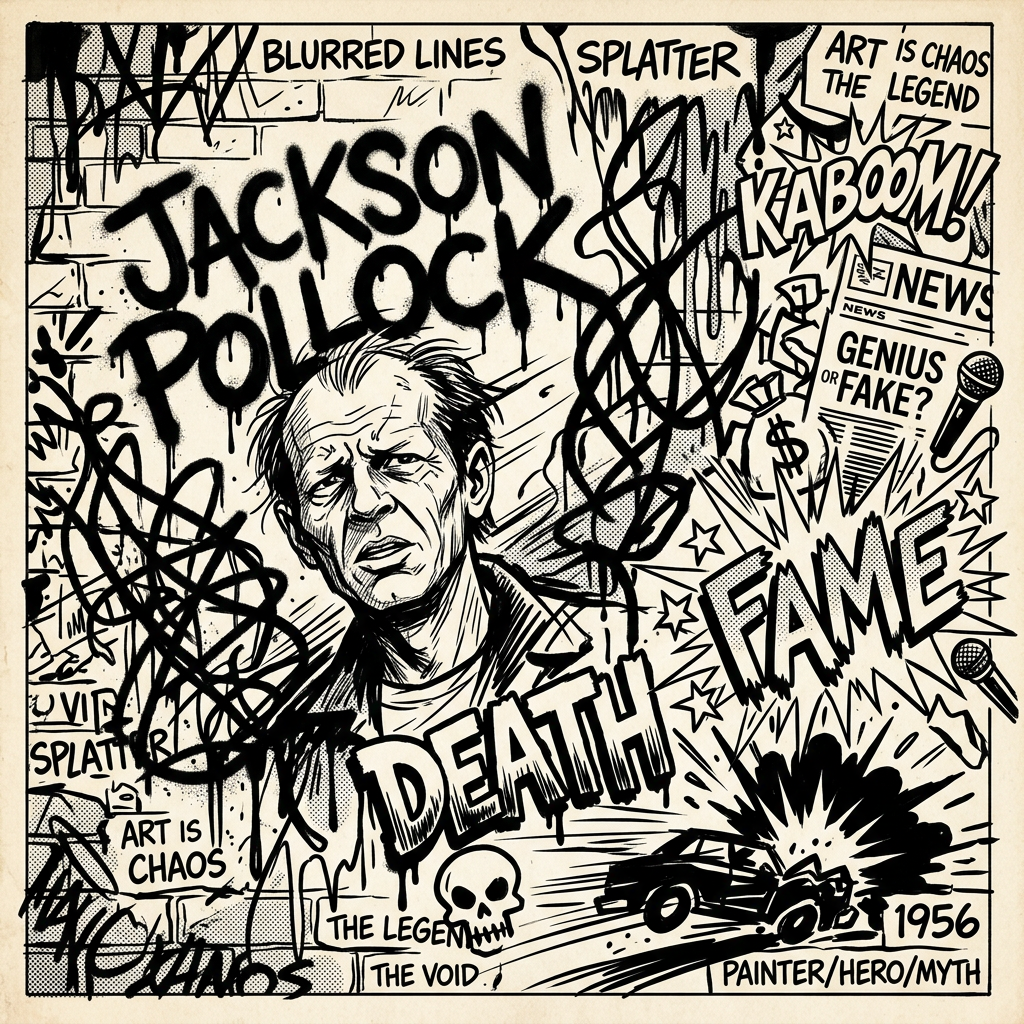
Jackson Pollock died on August 11, 1956, drunk, less than a mile from his house in Springs, Long Island. He went off the road and flipped the car. He was forty-four. He took a passenger with him, a woman named Edith Metzger. His girlfriend, Ruth Kligman, survived.
The prices went up. Everybody knows the prices went up. It is one of the load-bearing stories of the American art world, and it gets told like a warning and a promise at the same time: die correctly and they will finally understand you.
Except the story is wrong, and it is wrong in a way that matters if you are the kind of person who paints things that get removed.
He was already famous
On August 8, 1949, seven years before the tree, Life magazine ran a feature on Pollock. The headline asked whether he was the greatest living painter in the United States.
Life. The magazine that was in every dentist’s office in America. He was thirty-seven, and he was in the most widely read publication in the country, being asked, in print, if he was the best there was. The piece said he had burst forth as the shining new phenomenon of American art. It also went and found his grocer, who had bought a painting and told visiting salesmen it was an aerial view of Siberia.
By the time he got in that car he had a dealer, a critic who had built half his own reputation explaining him, a market, a mythology, and a public. The death did not make any of that. The death arrived somewhere that was already built.
So what did the death actually do?
It closed the edition. That is all. A living painter is a supply problem. He can make more, he can make worse ones, he can get sober and go figurative and embarrass everyone holding the early work. A dead painter is a fixed quantity. You can count it. You can price it. You can hang the last one and call it the last one and mean it.
Death did not make Pollock famous. Death made Pollock finishable. Those are different, and the difference is the whole thing.
KEZ5
Nestor Sanchez died on Mother’s Day, 2020, in Bushwick. He was forty-five. He had been released from the hospital about a day before.
He wrote KEZ5. He founded YKK. If you have ever looked up at something in this city and wondered how a human being got there, you have probably wondered it about his work. He put his name in the tunnels, on the trucks, on the bridges, in places that read as impossible. He wrote a book and called it The Graffiti Bible, which tells you exactly how seriously he took it and exactly how funny he found it.
When he died, The Source ran a notice. Writers posted. There were walls.
That is the whole apparatus. That is the entire machinery this city had available for a man who was, by any measure that means anything, one of the most visible artists in it. Millions of people saw his work. Almost none of them knew they were looking at an artist, and there was no institution standing by whose job it was to tell them.
KORN
Here is where it gets bleak, and here is where I have to correct myself.
Jeffrey Vanchiro wrote KORN. Smart Crew, Queens, up since 1995. The single K with the winking face. If you were in this city in the last thirty years, you have seen it, whether or not you registered it as anything.
He fell from a second-story window in December 2014. He was thirty-eight.
And people did care. That is the thing. Artforum ran an obituary. Artnet ran one. Complex ran one. The Times covered it. Writers and 5 Pointz painters put up murals and an ad takeover in the LES, and the Nets point guard wore neon sneakers on the court for him. For a graffiti writer, that is an unimaginable amount of attention. More than KEZ5 got. More than almost anyone gets.
Now ask why.
Because he was the Brooklyn Nets superfan. Because he wore neon to Barclays and lost his mind in the good way for a basketball team, and the Times had already profiled him for it, and there were photographs, and a name, and a face, and a story that fit in a newspaper.
The obituaries were for the man in the neon. The K with the winking face got in as a detail, in the second paragraph, as color.
He had been up for nineteen years and it took a basketball team to make him legible. He got through the door. He just did not get through the door he had spent nineteen years standing at.
Why the tag cannot die
Here is the structural problem, and I do not think it has a solution, or at least not one I would want.
Graffiti fame is already posthumous. That is what the name is for. You detach it from your body on purpose. It goes places you cannot go and it stays after you have run. It is famous while you are anonymous, and the whole point, the actual technology of the thing, is that the two never touch.
Pollock’s fame was welded to a biography. The Wyoming, the drinking, the analyst, the barn, the wife, the tree. So when he died, the death was an event inside the fame. It had somewhere to go. It went in.
A writer’s fame is welded to four letters. When the writer dies the four letters do not change. They do not gain anything. They just stop being refreshed, and then the buff comes, and the fame decays at the speed of paint.
You cannot write a biography of a tag. There is nothing to convert. Death has nothing to close, because the edition was never open, because there was never an edition, because it was never for sale.
The memorial wall
What we do instead is the wall.
Somebody gets the spot. Everybody comes. The letters are good, better than usual, because everyone is trying. People stand around in the cold. It is, and I say this with total sincerity, the most functional memorial practice I have ever participated in. Nothing an institution does comes close.
It is also a retrospective with a run of about eight months, in a venue with no address, for an audience of maybe two hundred people, all of whom already knew.
It is the only retrospective he gets. Then it is a Chase branch.
So, no
You do not have to die to be famous. Dying does nothing. Dying is not a career move and it is not a strategy and every writer I know who is gone is just gone, and the work is not appreciating, and there is no estate, and there is no catalogue, and there is no tree in Springs that anyone drives past.
What you have to be is on record. Somewhere. With somebody whose job is keeping it. While you are alive, because after is too late, because after there is no you to answer the question.
Pollock had Life magazine in 1949 and that is the only reason 1956 meant anything. KORN had a basketball team, so the art press found a door. KEZ5 had the tunnels and forty-five years and a book he wrote himself, and when he went, the record that existed was the one he had made with his own hands.
That is not a tragedy exactly. That is an instruction.
Build the record. Photograph the wall. Write the names down. Put it somewhere that is not a wall, because the wall is going, the wall was always going, that was the deal you signed.
Nobody is coming to do it for you. There is no Life magazine for this. There is no Greenberg. There is a hard drive and there is you.
Do it before the funeral. The funeral is not the exhibition. The funeral is just the day the archive stops growing.
Leave a Reply