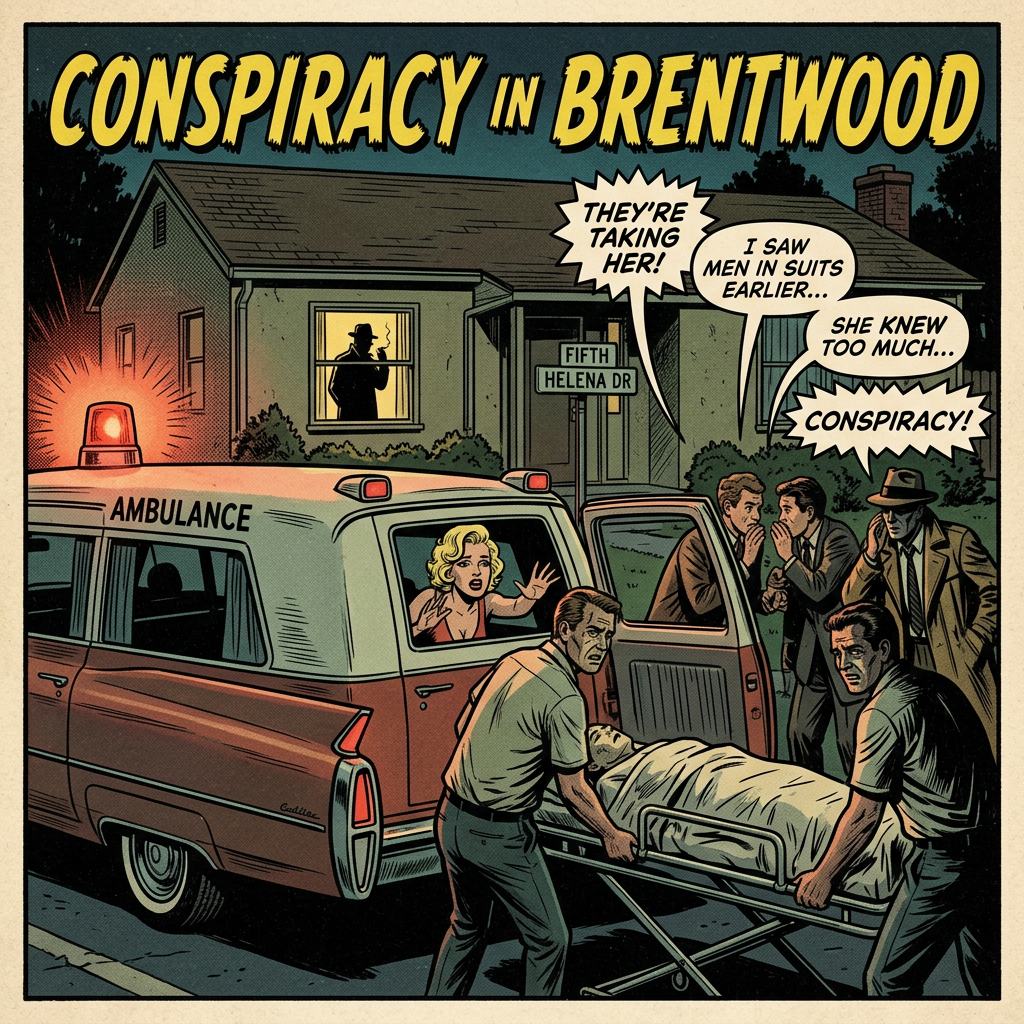
More than six decades after Marilyn Monroe’s death, the official story still reads like a tragedy written in advance: a lonely movie star, a late-night overdose, a body discovered in a locked bedroom, and a nation left to mourn. Yet around the edges of that narrative, the record is far from tidy. Conflicting timelines, missing records, and suspiciously coordinated statements have fueled an enduring alternative theory—that Monroe did not die in her bedroom at all, but in an ambulance after being removed from her home, and that powerful men connected to FBI Director J. Edgar Hoover may have had a vested interest in how the story was told.
This feature examines that theory in depth: the discrepancies in the official account, Hoover’s documented surveillance of Monroe and her ties to the Kennedy brothers, the claims about federal involvement in monitoring her, and the eyewitness accounts that place her alive, and moving, hours after she was supposedly found dead. None of this proves a murder conspiracy. But taken together, it raises serious questions about how and where Monroe died—and whether the truth was buried along with her.
The Official Story: A Tragic Overdose in a Locked Room
According to the official account, the 36-year-old Monroe died late on the night of August 4, 1962, or in the early hours of August 5, at her Brentwood home in Los Angeles. Her psychiatrist, Dr. Ralph Greenson, and her housekeeper, Eunice Murray, reported that Monroe had retired to her bedroom around 8 p.m. When Murray noticed a light still on in the early hours, she said she became concerned, found the door locked, and called Greenson. He allegedly broke a window, entered the room, and discovered Monroe lying nude on her bed, face down, clutching a telephone. Empty bottles of Nembutal and chloral hydrate, both powerful sedatives, were reportedly found nearby.
Police were called in the pre-dawn hours, and the Los Angeles County coroner soon ruled the death “probable suicide” due to an overdose of barbiturates. Investigators noted Monroe’s history of emotional instability, previous overdoses, and ongoing treatment for depression. In the official narrative, her death, while heartbreaking, was the culmination of a long struggle rather than the result of foul play.
Cracks in the Timeline: Inconsistencies and Contradictions
From the beginning, however, the timeline surrounding Monroe’s final hours was riddled with inconsistencies. Different witnesses offered conflicting accounts of when she was last seen alive, when she was discovered, and when authorities were actually notified. These discrepancies have become the foundation on which alternate theories, including the ambulance hypothesis, have been built.
One key issue is the reported time of death. The first officer on the scene, Sergeant Jack Clemmons of the LAPD, later claimed that Monroe’s body appeared to have been moved and staged in the bedroom. He also maintained that the atmosphere in the house was oddly calm and controlled for what should have been a chaotic, emergent situation. Clemmons said he was called to the scene shortly after 4:25 a.m., yet several later accounts suggested that Monroe may have died closer to midnight.
The statements of Monroe’s housekeeper and doctors changed over time. Murray’s recollections of when she noticed something was wrong, when she contacted Greenson, and when the bedroom door was forced open shifted in subsequent interviews. Dr. Hyman Engelberg, Monroe’s personal physician, offered differing times for when he was told of her condition. These contradictions have led some researchers to suspect that the early hours after Monroe’s collapse were not simply confused, but actively managed.
Medical details also raise questions. Despite the supposed oral overdose, there was an absence of visible pill residue in Monroe’s stomach, according to the autopsy report. There was also a lack of obvious water containers or glasses in the room, which would typically be needed to ingest such a large quantity of barbiturates. While toxicologists have offered various explanations, these discrepancies have opened the door to alternative scenarios about how, when, and where the drugs entered Monroe’s system—and whether she was already beyond help by the time she was placed on her bed.
Under Hoover’s Gaze: Surveillance, Files, and the Kennedy Connection
To understand why Monroe’s death would have been of interest to J. Edgar Hoover, it is necessary to consider who she was spending time with in the months and years prior. By 1962, Monroe had been romantically linked to both President John F. Kennedy and his brother, Attorney General Robert F. Kennedy—men who were already at odds, publicly and privately, with Hoover, the powerful director of the FBI.
Declassified FBI files confirm that Monroe was under some level of federal surveillance. Hoover’s Bureau kept tabs on many high-profile Americans whom he believed might be security risks, subversives, or useful leverage points. Monroe’s associations with left-leaning intellectuals, her expressed sympathy for labor causes, and suspicions about her views on communism all found their way into FBI memoranda. Reports in later years suggested that Hoover saw Monroe not just as a movie star, but as a potential conduit to the Kennedy inner circle.
Hoover’s power within Washington at the time is difficult to overstate. He had spent decades building expansive domestic intelligence networks, amassing files on politicians, activists, celebrities, and even presidents. His relationships with multiple administrations were characterized by a mix of cooperation and veiled threat. If damaging information about the Kennedys could be gleaned from Monroe—or if a scandal involving her could weaken them—it is not hard to imagine why her private life might have been of special interest.
None of this proves that Hoover ordered or endorsed any action against Monroe. But the confirmed surveillance, the political stakes surrounding the Kennedys, and the culture of secrecy that defined Hoover’s FBI create a context in which Monroe’s death, and the management of its aftermath, take on more than purely personal significance.
Were Federal Agencies Watching—or Worse?
Conspiracy theories about Monroe’s death often hinge on the idea that she knew too much. Some accounts claim she kept a “red diary” in which she allegedly recorded private conversations with the Kennedys about sensitive political topics, including Cuba, nuclear policy, and organized crime. While the existence and contents of such a diary are hotly disputed, the mere possibility would have been alarming to national security officials and political operatives alike.
Researchers who argue for federal involvement point to the broader pattern of FBI and CIA monitoring of public figures during the Cold War. It is a matter of public record that both agencies engaged in extensive domestic surveillance, sometimes bending or breaking legal limits in the name of national security. In Monroe’s case, FBI files show a detailed interest in her associations and political leanings. CIA documents are less clear, with the agency publicly denying any operational involvement with her, but the culture of compartmentalization leaves room for speculation about what may not have been documented in a straightforward way.
Some former intelligence and law enforcement figures, speaking decades after the fact, have suggested off the record that Monroe was “on the radar” of multiple agencies because of her proximity to the Kennedys. Others, however, argue that while she was monitored, the idea of an organized plot to kill her stretches credibility. What is less disputed is that her death, and the potential fallout for the White House, would have been of intense interest to Hoover and his counterparts in the intelligence community.
Eyewitness Accounts: Was Marilyn Alive When She Left the House?
The standard version of events holds that Monroe was found dead in her bedroom and that her body never left the house until it was transported to the morgue. But a very different picture emerges from several later accounts, particularly those involving ambulance personnel and neighbors, which suggest that Monroe may have been alive when she was first removed from the scene.
In interviews conducted years after the event, some individuals who claimed to have been involved in emergency response that night described finding Monroe unconscious but not yet deceased. According to these accounts, resuscitation attempts were made and she was placed in an ambulance for transport to a hospital. One version of the story suggests that Monroe went into full cardiac arrest en route, and that efforts to revive her in the ambulance ultimately failed.
There are also scattered claims from neighbors who reported seeing unusual activity, including emergency vehicles and movement in and out of the house, at times that do not align neatly with the official police log. These accounts are difficult to verify independently, especially given the decades that have passed and the fallibility of human memory. Yet they form a core component of the ambulance theory: if Monroe was alive when first removed and later died in transit, then the widely accepted image of her lifeless body in a locked bedroom may have been, at best, an incomplete snapshot of a more complicated sequence.
The Ambulance Theory: What Was Allegedly Witnessed, and Why It Matters
The “ambulance theory” coalesced over the years as researchers and journalists collected and compared these alternative testimonies. In some versions, private ambulance services—then common in Los Angeles—were called before official authorities. The story often centers on paramedics or attendants who later claimed that they worked on Monroe in the ambulance, only to be told afterward that the official story would be that she died at home.
One recurring allegation is that someone with influence—often vaguely described as being connected to law enforcement or federal agencies—intervened, instructing that the narrative of an on-scene death in the bedroom be locked in. In this telling, the reason is pragmatic: a controlled scene at home was easier to manage than a chaotic, public death at a hospital, which would have created more witnesses, more paperwork, and more opportunities for awkward questions about who had visited Monroe that day, what was said, and what substances were found in her system.
Why does it matter where Monroe took her last breath? The difference between dying at home and dying in an ambulance is more than semantic. If she was alive when removed, it implies a delay in calling for help, discrepancies in the reported timeline, and potential manipulation of the scene after the fact. It also raises the possibility that certain people may have had time to enter or leave the house, remove items, or coordinate stories before the official machinery of law enforcement fully engaged.
Critics of the ambulance theory point to the lack of contemporaneous documentation—no surviving ambulance logs, no hospital intake forms, no official records that clearly corroborate a transport in progress. Supporters counter that if a cover-up was in motion, those are precisely the kinds of documents that would have been most vulnerable to quiet alteration or disappearance. The absence of evidence, in this case, is interpreted not as proof of absence, but as a symptom of something larger being hidden.
Inside the Alleged Cover-Up: Motives, Access, and Missing Records
If the official story was, in some way, constructed or sanitized, who would have had both motive and means to orchestrate such a cover-up? The list of potential players is short but powerful: local law enforcement and medical authorities, members of Monroe’s inner circle, and figures connected to the Kennedy administration or Hoover’s FBI.
For the Kennedys, Monroe’s sudden death threatened to ignite a scandal that could have had severe political consequences. Rumors of affairs, already circulating in Washington and Hollywood, would have taken on a far darker tone if they intersected with a mysterious, high-profile death. For Hoover, who had a history of leveraging sensitive information to maintain his position, a carefully managed narrative around Monroe may have been an opportunity to either shield or pressure the administration, depending on what emerged.
Researchers who argue that a cover-up occurred often point to what they see as conspicuous absences in the record. Accounts describe Monroe’s phone records as incomplete or missing for critical periods. The infamous “red diary” has never surfaced in a verifiable way, with some claiming it was removed from the house before police arrived. Statements from key witnesses were sometimes taken without recordings or detailed contemporaneous notes, leaving only later recollections and fragmentary documentation.
There are also questions surrounding the handling of Monroe’s autopsy and toxicology reports. Some experts have argued that the level of barbiturates found in her system is difficult to reconcile with the absence of pill residue in her stomach, suggesting other routes of administration that would have required access and opportunity. Others counter that the science of the time, combined with the limitations of the autopsy, make definitive conclusions impossible. Either way, the ambiguities have been fertile ground for speculation that critical details were omitted, soft-pedaled, or lost.
J. Edgar Hoover, Power Politics, and the Management of Scandal
Any theory implicating figures linked to Hoover in Monroe’s death must grapple with both his known methods and the limits of what the historical record can prove. Hoover did not need to directly order a crime to influence how events were interpreted, investigated, or reported. His sway over the FBI, his relationships with local law enforcement, and his deep knowledge of political vulnerabilities meant that he could, at a minimum, shape the informational environment surrounding a high-profile death.
Hoover’s FBI has been credibly documented as engaging in surveillance, blackmail, and the quiet management of scandals involving prominent Americans. In that context, the idea that operatives connected to him might have had an interest in the timing and presentation of news about Monroe’s death is not far-fetched. Whether that interest extended to active participation in a cover-up, or even in causing her death, is where the evidence grows thin, relying heavily on secondhand accounts, anonymous sources, and interpretations of what is missing rather than what is documented.
Still, the theory persists that Hoover or those aligned with him saw Monroe as a potential liability and that her death—however it occurred—was quickly reframed in a way that minimized damage to institutions Hoover sought either to protect or to control. The alleged ambulance episode, in this light, becomes a pivotal moment: a juncture at which a private medical emergency could either become a public spectacle or be redirected into a controlled narrative of lonely despair.
Weighing the Evidence: Between Myth and Possibility
After decades of books, documentaries, and investigative forays, the Marilyn Monroe case sits at a crossroads between myth and unresolved history. On one side is the official story, supported by primary documents, police and coroner records, and the weight of institutional endorsement. On the other is a patchwork of contradictions, missing pieces, and belated testimonies that, while often imperfect, refuse to fit neatly within the authorized version.
The ambulance theory exemplifies this tension. It cannot be conclusively proven with the evidence currently available, yet it also cannot be easily dismissed as pure fantasy. The inconsistencies in the timeline, the shifting statements of key witnesses, and the broader context of federal surveillance and political anxiety lend it a measure of plausibility that keeps researchers and readers alike returning to the scene in their minds, trying to reconstruct those crucial hours.
Responsible examination of such theories requires a careful balance. It is essential to distinguish what is documented from what is inferred, what is eyewitness testimony from what is rumor, and what is politically convenient from what is historically supported. At present, there is no smoking gun that proves Marilyn Monroe was killed by operatives connected to J. Edgar Hoover, nor that she definitively died in an ambulance rather than in her bedroom. But the unresolved questions surrounding her death, the documented surveillance by federal agencies, and the patterns of secrecy that defined the era make it reasonable to take the anomalies seriously.
A Measured Conclusion: An Unfinished Investigation
In the end, the story of Marilyn Monroe’s death may be less about a single, provable conspiracy than about the uneasy intersection of power, privacy, and narrative control in Cold War America. The possibility that she died in an ambulance, that her final moments unfolded out of public view and were later folded back into a carefully staged bedroom tableau, is emblematic of a larger pattern in which official accounts sometimes smooth over the messier truths of history.
Until new, verifiable evidence emerges—in the form of credible, contemporaneous documentation or undisputed firsthand testimony—the theory that Monroe was killed by operatives linked to Hoover will remain unproven. Yet the lingering inconsistencies, missing records, and shadows cast by Hoover’s known surveillance ensure that this line of inquiry will not easily fade. For now, the most honest position is one of informed skepticism: acknowledging that the official story answers some questions, but not all, and that the precise circumstances of Marilyn Monroe’s final hours may never be fully, definitively known.
Leave a Reply