Every writer in this city has a relationship with fire escapes. It is not sentimental. It is practical. A fire escape is how you get to the roof. It is the difference between a spot and a spot you can actually paint. You learn which ones drop, which ones are bolted short, which ones will announce you to the whole block when your foot hits the first rung.
Then you sit on it. That is the other half. You sit on it in July because the apartment is unbearable. You put a plant on it. You smoke on it. You have the entire conversation that ends the relationship on it. The iron gets hot and then it gets cold and you stay out there anyway.
Neither of those is what it is for. It was built to be used once, downward, by someone who is running.
Elm Street, 1860
On February 2, 1860, a fire started on the ground floor of a tenement at 142 Elm Street. Twenty-four families lived in the building. Elm Street is Lafayette now, just north of Howard. You have walked past it. There is nothing there to tell you.
Seven years later New York passed the Tenement House Act of 1867. It was the first comprehensive housing law in the country. It required a fire escape for every unit and a window in every room.
The law was barely enforced. Landlords built the cheapest thing that satisfied an inspector, which meant a straight iron ladder bolted to the front of the building. That is the origin of the object. Not design. Not the New York look. A cheap way to comply.
1901, and the balcony
Here is the part I did not know until I went looking.
The balcony is not incidental. It is legislated. Before 1901, tenement fire escapes were mostly straight ladders, which you cannot sit on and cannot really flee down either. The Tenement House Act of 1901 required fixed staircases running between balconies, and it specified when, how, and where. For the first time the rules were actually enforced. The face of every tenement neighborhood in this city changed inside of a few years.
So the flat platform outside your window, the one you have been sitting on your whole adult life, is a 1901 legal requirement. Somebody wrote a specification for it. The specification exists because people who lived in buildings like yours died in buildings like yours, over and over, for forty years, until the law got specific.
The tenants understood immediately that it was also a room. That was never the plan and nobody could stop it.
March 25, 1911
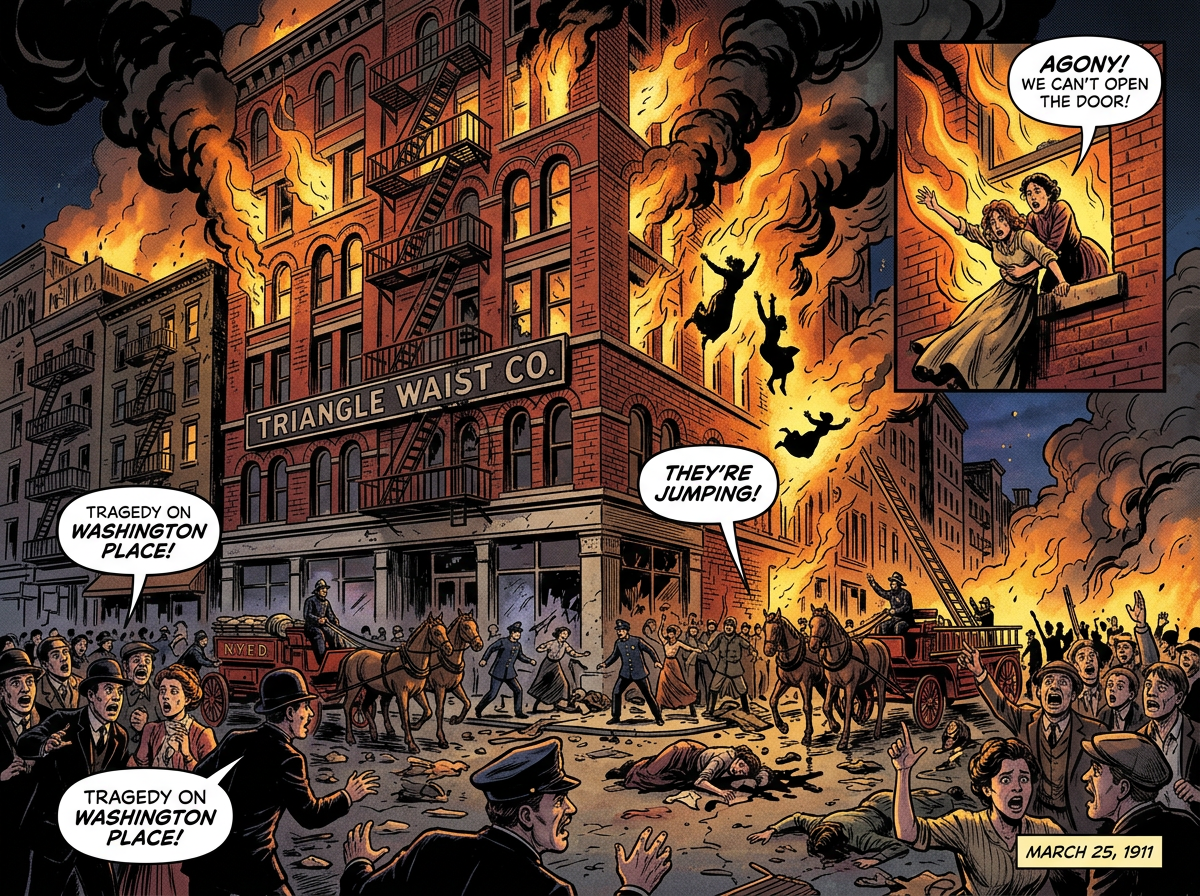
The Triangle Shirtwaist Factory took up the top three floors of the Asch Building, at Washington Place just east of the park. Around five hundred people worked there, most of them young immigrant women. On a Saturday afternoon a fire started in a scrap bin on the eighth floor.
One of the two stairways was locked from the outside, to stop the workers from stealing. The other opened inward, which means a crowd pressing against it seals it. The fire truck ladders stopped six floors up. The fire was on eight.
And there was a fire escape.
This is the part that I cannot get past. The building had one. In 1911 the law left factory fire escapes to the judgment of building inspectors, and an inspector had judged. The architect had promised it would run down to the yard, with an additional balcony. It did not. As built, it ended at a second-floor skylight, which is a way of saying it ended nowhere.
People got onto it. It collapsed under them.
The rest is the part everyone knows. They went out the windows because the windows were what was left. It was over in about half an hour. One hundred forty-six dead.
What actually changed
Triangle did not invent the fire escape. It had been required in tenements since before anyone in that building was born.
What Triangle did was end the era of the gesture. New York put together a Factory Investigating Commission and sent it into buildings all over the state, and what came out of it was the most comprehensive workplace safety law in the country. Doors that open outward. Doors that stay unlocked while people are inside. Enough exits for the number of bodies. Fire drills. Inspection with teeth.
The lesson was not that people need a fire escape. Everyone already knew that. The lesson was that a fire escape which exists on paper, satisfies an inspector, and ends at a skylight will still let a hundred and forty-six people die. The object is not the safety. The enforcement is the safety. The object is just iron.
The thing itself
I think about this every time I go up one.
A fire escape is not a monument. Nobody bolted it to the building to make you remember anything. There is no plaque. It is the opposite of a monument: it is a thing installed so that the event would not need remembering, because it would not happen again.
And then we made it a balcony. We put chairs on it. We climbed it in the wrong direction to get to a roof and paint something that will be buffed by August. The city’s most consistent piece of memorial architecture is the one nobody reads as memorial, because it is too useful, and because it is outside everybody’s window, and because a thing you see ten thousand times becomes weather.
That is not disrespect. I have decided it is the opposite. The women on the ninth floor were not trying to be remembered. They were trying to get out of the building and go home. What they got instead, eventually, decades late and paid for in a way nobody should have to pay, was a city where the way out is required to actually go somewhere.
You climb it to get to the roof. Someone died so that it would be there and so that it would hold. Both of those are true at the same time, and the second one does not need you to stop doing the first.
It just needs you to know that the iron under your hand is an argument that somebody won.
Leave a Reply